Gulf Coast summers, heavy rain and mild winters all shorten the life of a ground cover. Here is how to tell when your beds are due, and what a refresh actually involves.
Pine straw does not fail all at once. It thins, fades and settles gradually, and because the change is slow it is easy to look at a bed every day for a year without noticing it has stopped doing its job. On the Gulf Coast that decline runs faster than it does inland: hot, humid summers break the needles down quickly, heavy rain packs them flat and washes them off slopes, and the growing season barely pauses long enough for a bed to rest.
The signs a bed is due
There are four worth watching for, and any one of them is reason enough to top up.
- Depth. A working bed sits at two to three inches. Push a finger in — if you reach soil before the first knuckle, there is not enough straw left to suppress weeds or hold moisture.
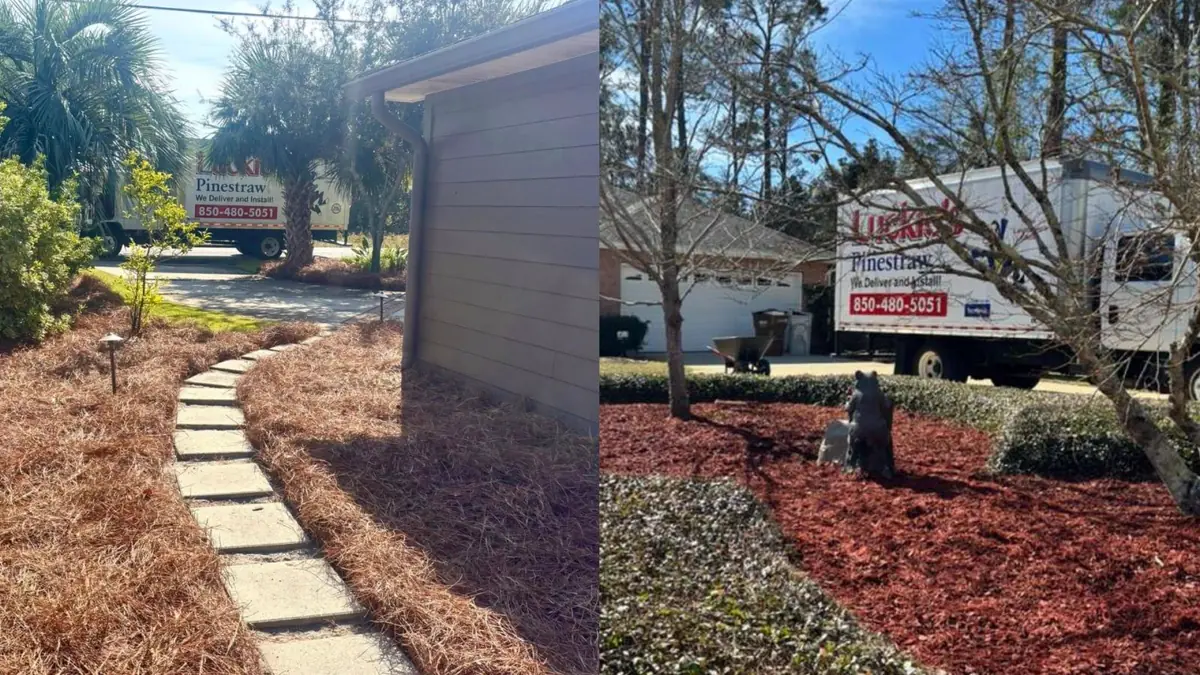
- Color. Fresh longleaf is a warm copper that weathers to a soft brown. Gray and brittle means the needles have broken down rather than simply aged.
- Weeds. Sudden weed pressure in a bed that was previously clean usually means light is reaching the soil through a thinning layer.
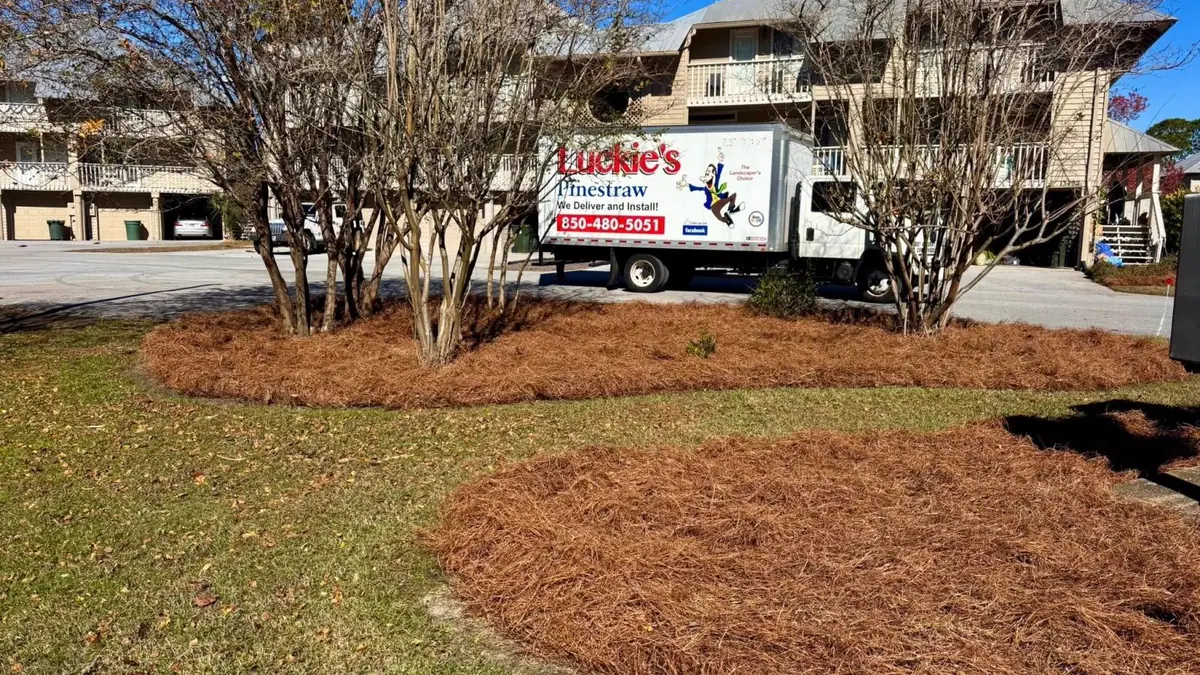
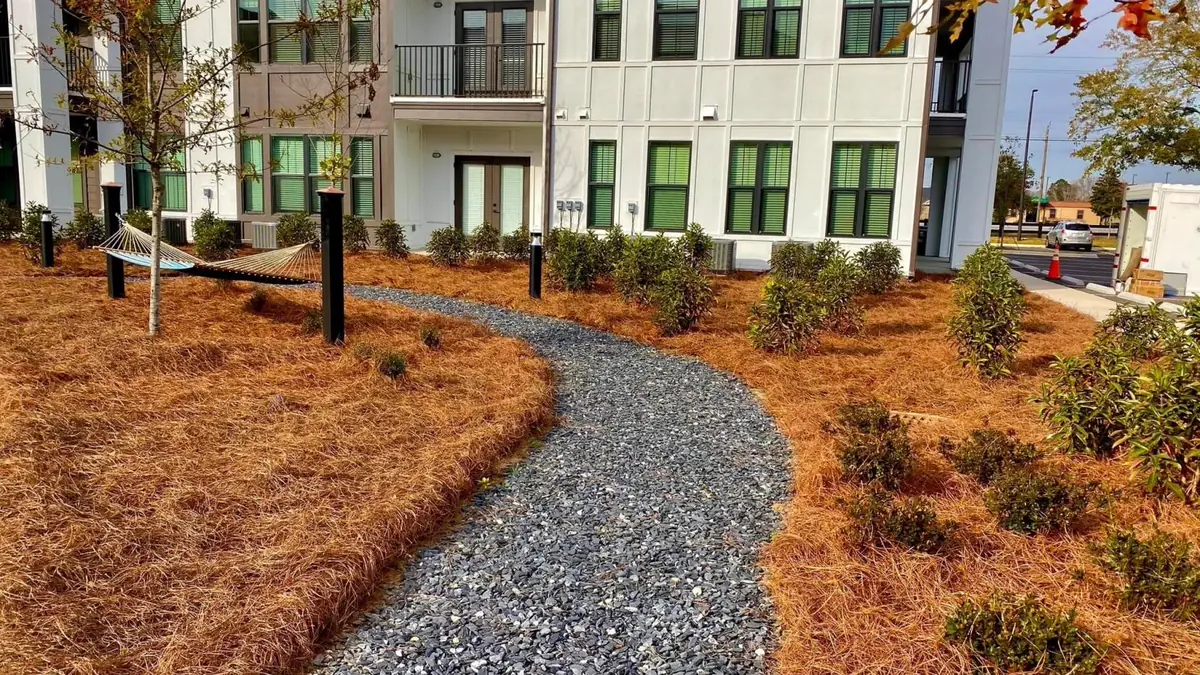
- Edges. Bed lines that have gone soft and indistinct, or straw that has crept out onto the lawn, are the clearest sign from the street.
How often, realistically
Most properties in this area refresh once or twice a year, and which one depends less on the calendar than on the bed. A shaded bed under mature oaks, protected from direct sun and hard rain, will often hold its look for a full year. An exposed bed facing south, or one on a slope that sheds water in a summer downpour, will not.
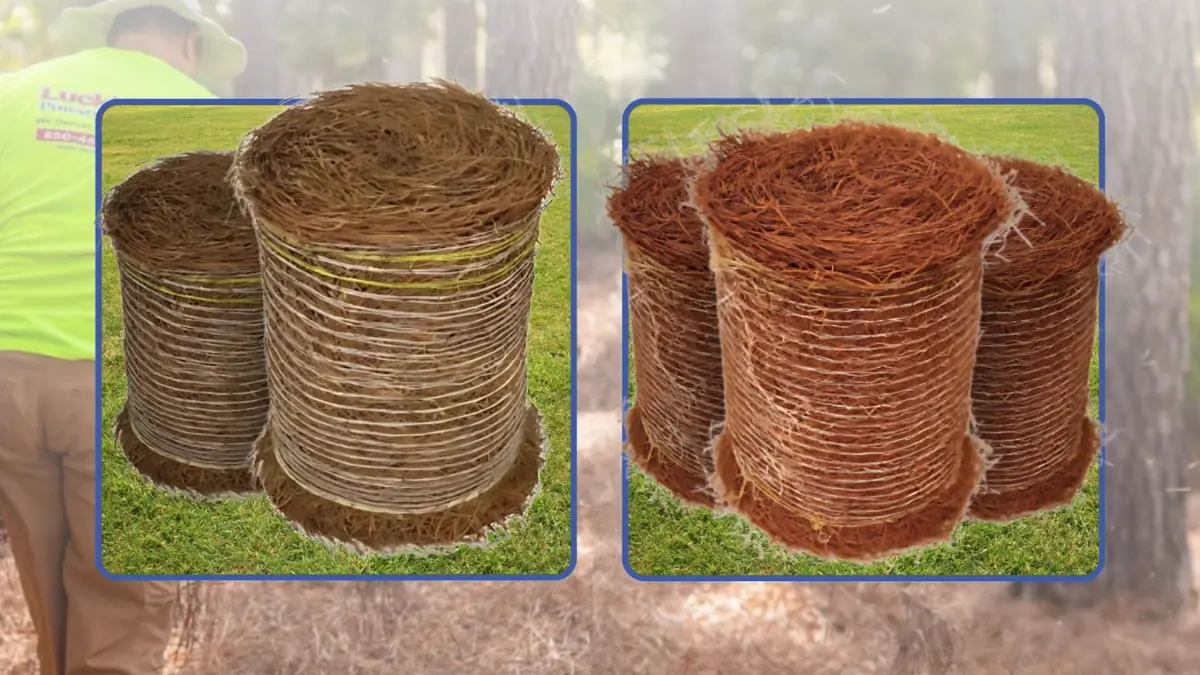
Dyed red rolls change the arithmetic. The plant-safe pigment holds a vibrant ruby color for up to nine months, which is long enough that a single application can carry a property through the season where natural straw would have faded and needed a second visit.
What a refresh involves
A refresh is not the same as a fresh installation. In most cases the existing layer stays where it is and new straw goes over the top, which is both cheaper and better for the soil — the old needles are already breaking down into it.
What matters is that the new layer goes on evenly at two to three inches, that the baling twine comes out rather than getting buried, and that the edges are cut back in. We finish edges one of two ways: Trench and Tuck, where a three-inch trench is cut along the bed line and the straw tucked down into it, or Curling, where the edge is rolled under itself with a blower. Both restore the crisp line that makes a bed read as maintained rather than merely covered.
Working out what you need
Each longleaf roll covers roughly 140 square feet — the equivalent of 2.5 to 3 square bales — and weighs 29 to 36 lbs. Measure your beds, total the square footage and divide by 140 for a rough count. A refresh usually needs less than a first installation, since you are topping up rather than building the layer from bare soil.
Longleaf rolls are $13.95 and dyed red rolls are $24.95, with installation a flat $10 per roll on top. If you would rather not measure, an estimate is free — call 850-480-5051 and we will work it out on site.
Get a Free Estimate
We serve Pensacola, Gulf Breeze, Pace, Cantonment, Navarre and Perdido. Tell us about your beds and we will price the material and the labor together.